Robust Theme
Dec 09, 2019 2020-04-08 7:40Robust Theme


Parshat Devarim: The Stories We Tell at the Edge of Change
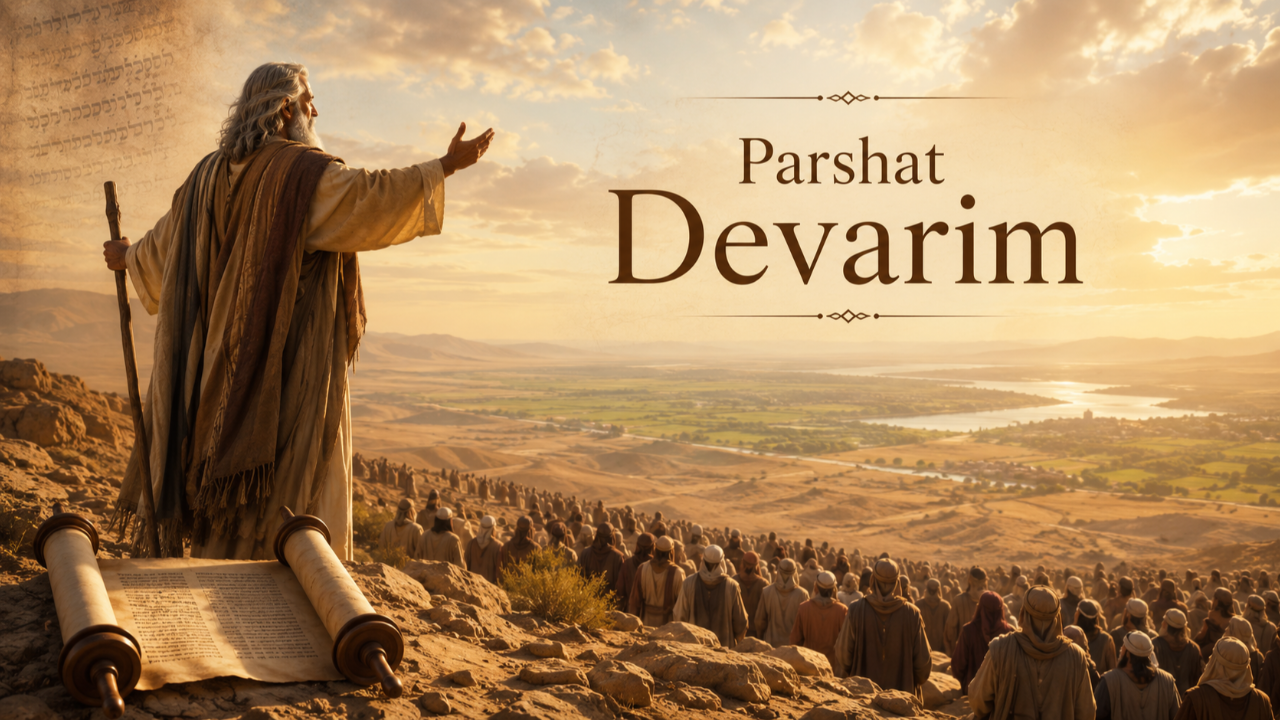
“These are the words that Moses spoke to all Israel on the other side of the Jordan, in the wilderness…”
Deuteronomy 1:1
There are moments when the future cannot begin until the past has been spoken.
Parshat Devarim opens with the Israelites standing at the edge of the Promised Land. Forty years of wandering are behind them. The Jordan River lies ahead. A generation born in the wilderness is preparing to enter a place it has known only through promise and imagination.
This should be a moment of pure anticipation. Yet Moses does not begin by describing the beauty of the land or the triumphs that await them.
He begins by remembering.
He recalls the long journey through the wilderness. He speaks of hesitation, conflict, rebellion, fear, and failure. He reminds the people of the spies who discouraged the nation, of their refusal to trust, and of the consequences that followed.
Why reopen these painful chapters at the very moment when a new beginning is possible?
Because a new beginning without reflection is often only an old pattern in a new place.
Memory as a Moral Practice
The Torah does not treat memory as nostalgia. To remember is not simply to look backward. It is to allow the past to teach us how to live differently in the future.
Moses understands that crossing the Jordan will not automatically transform the people. Geography alone cannot heal fear. A new land cannot, by itself, create a new heart.
The Israelites will carry their memories with them. They will also carry their habits, anxieties, wounds, and unfinished conflicts. Before they enter the land, Moses asks them to examine what they have learned in the wilderness.
The same is true in our own lives.
We often imagine that change will come through a new job, a new home, a new relationship, a new year, or a fresh opportunity. We tell ourselves that once we cross a certain threshold, everything will be different.
But we cross every threshold carrying ourselves.
Unless experience becomes wisdom, we may recreate the wilderness even after we have reached the promised land.
Devarim invites us to ask not merely, “What happened to me?” but, “What is this experience asking me to understand?”
What did fear teach me?
Where did impatience lead me?
When did I fail to listen?
Who sustained me when I believed I was alone?
What strength emerged only because the road was longer than expected?
Sacred memory does not imprison us in the past. It releases the wisdom hidden within it.
The Tenderness of Rebuke
The opening verse of Devarim lists several places associated, according to the classical commentators, with moments when the Israelites failed. Rashi explains that Moses refers to these failures indirectly. Rather than accuse the people in explicit detail, he alludes to the locations where their mistakes occurred.
Moses tells the truth, but he does not humiliate.
This is an extraordinary model of moral leadership.
There is a way of speaking truth that is meant to display our own righteousness. There is another way of speaking truth that is meant to help another person grow.
The difference is often found not in the content of the words but in the heart of the speaker.
Rebuke without love becomes cruelty. Love without honesty becomes avoidance. Moses attempts the more difficult path: honesty held within compassion.
The Hebrew word tochachah, often translated as rebuke, can also suggest clarification or making something visible. At its best, correction is not an attack. It is an act of helping another person see what they may not yet be able to see for themselves.
This requires humility.
Before offering criticism, we might ask:
Am I speaking to repair the relationship, or to win?
Am I protecting the other person’s dignity?
Have I made room for the possibility that I, too, may be mistaken?
Will my words open a door, or merely leave a wound?
Moses teaches that difficult truths can be spoken without stripping another person of dignity. Words can awaken responsibility without creating shame.
“You Have Stayed Long Enough”
Early in the parashah, Moses recalls God’s command at Mount Sinai:
“You have stayed long enough at this mountain. Turn and journey onward.”
Deuteronomy 1:6–7
The people had received revelation at Sinai. They had heard the Divine voice. They had encountered holiness in fire, cloud, trembling, and silence.
Yet even Sinai was not meant to become a permanent home.
There comes a time when revelation must become movement.
It is possible to remain attached even to a sacred moment. We may cling to an insight, an identity, a grief, or a former version of ourselves because it once gave us meaning. But what was once a place of revelation can become a place of stagnation if we refuse to move onward.
“You have stayed long enough at this mountain” is not a rejection of Sinai. It is the fulfillment of Sinai.
The purpose of receiving Torah is to carry it into the world.
The purpose of insight is to shape action.
The purpose of prayer is to make us more present, more compassionate, and more courageous when we return to ordinary life.
Every spiritual mountain eventually asks us to descend.
The question is not whether we have experienced inspiration. The question is what our inspiration has taught us to do.
From Wilderness to Words
The Hebrew name Devarim means “words.” The book begins, Eleh hadevarim—“These are the words.”
There is a quiet transformation hidden here.
Earlier in the Torah, Moses insists that he is not a man of words. At the burning bush, he protests that he is slow of speech. Yet now, near the end of his life, an entire book flows through his voice.
The hesitant speaker has become the teacher of a nation.
Perhaps Moses did not find his voice all at once. Perhaps his voice emerged through years of responsibility, disappointment, prayer, argument, courage, and love.
The wilderness did not merely delay Moses. It formed him.
This may be one of Devarim’s most hopeful teachings: the place where we feel least capable may eventually become the place from which our deepest contribution emerges.
The one who struggled to speak may one day offer words that guide generations.
The one who wandered may become a guide.
The one who was broken may learn how to accompany others through brokenness.
Our limitations are real, but they may not be final.
Devarim and Tisha B’Av
Parshat Devarim is always read close to Tisha B’Av, the day on which Jewish tradition mourns the destruction of the Temples and other tragedies in our history.
The connection is especially vivid in the word eichah—“How?”
In Devarim, Moses cries:
“How can I bear alone your burden, your weight, and your quarrels?”
Deuteronomy 1:12
The Book of Lamentations begins:
“How does the city sit alone, once full of people?”
Lamentations 1:1
The same word expresses astonishment, grief, and the painful recognition that something has gone deeply wrong.
How did we arrive here?
How did a community become divided?
How did people who once stood together become strangers?
How did words meant to connect become instruments of contempt?
Tisha B’Av asks us to mourn not only ancient ruins but the patterns of destruction that continue to appear in human relationships: hatred, humiliation, indifference, and the refusal to recognize the sacredness of another person.
Yet Jewish mourning is never the worship of despair. We remember destruction so that we may become builders.
We fast so that we may become more sensitive to hunger.
We grieve exile so that we may create belonging.
We mourn the consequences of hatred so that we may practice a more courageous love.
The movement from Tisha B’Av toward consolation begins when the question “How did this happen?” becomes “What can I help repair?”
Standing at Our Own Jordan
Every person eventually stands where Israel stands in Devarim: between wilderness and promise, between what has been and what may yet be.
At such moments, the Torah does not ask us to erase the past. It asks us to interpret it.
We are invited to remember without becoming trapped in memory.
To take responsibility without surrendering to shame.
To speak honestly without humiliating.
To honor the mountain where we received wisdom, and then to continue the journey.
Perhaps the promised land is not a place where the past disappears. Perhaps it is the place where the past is finally transformed into wisdom.
As we enter the coming week, we might ask:
What story about my past am I ready to understand differently?
What truth needs to be spoken with greater kindness?
At which mountain have I stayed long enough?
What wisdom from my wilderness am I now ready to carry forward?
Moses stands at the border and offers his final gift: words shaped by memory, love, and urgency.
His message still reaches us:
Look back honestly.
Speak gently.
Learn deeply.
Then turn—and journey onward.
Shabbat Shalom.
